Core Principles of the Montessori Method
Understanding the fundamental concepts that guide the Montessori approach to education, from respect for the child to the prepared environment.
Montessori is often reduced to visuals: wooden materials, calm shelves, mixed-age classrooms.
Those elements matter, but they are not the core.
At its heart, Montessori is a coherent developmental philosophy: a way of understanding the child, designing environment, and structuring adult behavior so human potential can unfold with dignity and precision.
This article deepens the core principles behind the method and shows how they translate into practical decisions at home and in classrooms.
1. Respect for the Child Is the Foundational Principle
Montessori respect is not permissiveness. It is recognition of personhood.
To respect the child means:
- treating the child as an active constructor of self,
- protecting concentration,
- offering meaningful choice within clear limits,
- and speaking to children with the same dignity we expect in adult relationships.
In practice, respect appears in small moments:
- waiting before interrupting focused work,
- inviting participation rather than commanding compliance,
- correcting behavior without humiliating the person.
Respect is the first condition for independence, trust, and internal discipline.
2. The Absorbent Mind: Why Early Environment Matters So Much
In the first plane of development (0-6), children learn with extraordinary intensity through immersion, repetition, and relationship.
Montessori called this the absorbent mind: the child does not merely receive information; the child forms self and worldview through daily experience.
This has major implications:
- environment is never neutral,
- adult tone and rhythm are educational inputs,
- repeated patterns become internal psychological structure.
Because of this, Montessori emphasizes consistency, order, and emotionally regulated adult behavior in early years.
3. Sensitive Periods: Timing Changes Everything
Children do not learn all capacities with equal readiness at all times.
Montessori observed windows of heightened sensitivity for specific domains, such as:
- movement,
- language,
- order,
- sensorial discrimination,
- social behavior.
When adults align support with a sensitive period, effort decreases and growth accelerates.
When timing is ignored, learning may still happen, but often with more resistance and less joy.
Sensitive periods do not justify pressure. They justify informed opportunity.
4. The Prepared Environment: The Silent Teacher
A prepared environment is not decoration. It is functional pedagogy. The Association Montessori Internationale describes the environment as a deliberately organized setting with accessible furniture, varied work spaces, ordered materials, free choice after presentation, and a trained adult.
Core design attributes include:
- Order: clear structure and predictable placement.
- Accessibility: child can independently reach and use materials.
- Beauty: calm aesthetics that support attention.
- Purpose: each material has developmental intent.
- Reality: tasks are connected to real life, not only entertainment.
When environment is prepared well, adults can speak less and observe more.
When environment is poorly prepared, adults must control constantly.
5. Freedom Within Limits: The Discipline Paradox
One of the most misunderstood Montessori ideas is freedom.
Montessori freedom is not "do whatever you want." It is structured autonomy:
- freedom to choose meaningful work,
- freedom to repeat,
- freedom to move purposefully,
- within boundaries that protect safety, materials, and others' concentration.
This is why Montessori discipline is often called "inner discipline."
Children build self-control because they repeatedly practice choice, consequence, and responsibility.
6. Auto-Education: The Child as Active Learner
Montessori assumes that children are naturally driven to develop themselves when conditions are right.
The adult does not "install" learning. The adult:
- prepares conditions,
- presents clearly,
- observes accurately,
- adjusts support precisely.
This principle is sometimes summarized as help me do it myself.
Auto-education does not remove the adult. It refines the adult role from controller to developmental guide.
7. The Hand-Mind Connection: Why Work with the Hands Matters
Montessori repeatedly linked manual activity with cognitive formation. Her line about the hands being the instruments of intelligence comes from *The Absorbent Mind*, page 25; the Association Montessori Internationale reproduces the quotation with its source.
Hands-on activity supports:
- sequencing,
- attention regulation,
- motor planning,
- conceptual abstraction through concrete experience.
This is why practical life work and sensorial work are not "pre-academic extras."
They are the cognitive infrastructure for later literacy, numeracy, and reasoning.
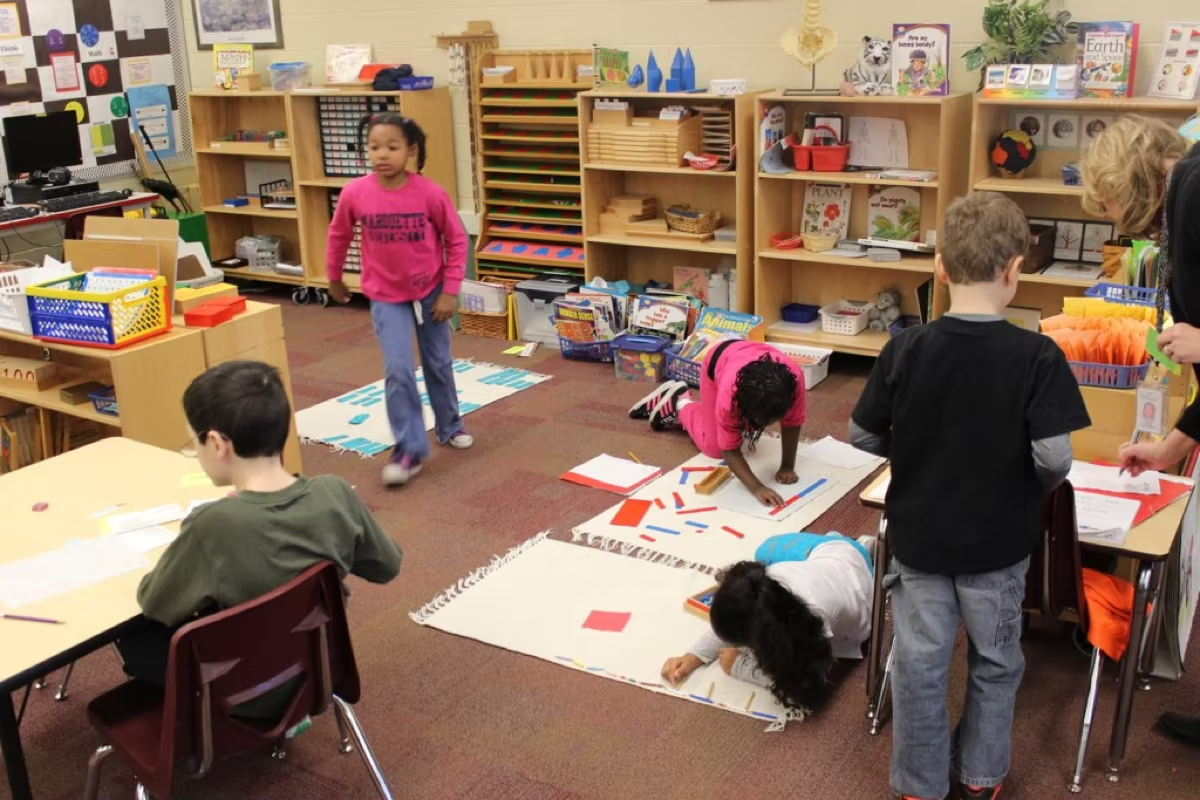
Image source: Wikimedia Commons
8. Observation: The Core Adult Practice
Montessori adults are trained to observe before intervening.
Observation helps answer:
- What is the child trying to achieve?
- Where is the true difficulty?
- Is support needed in skill, environment, or emotional regulation?
Without observation, adults often over-help, over-correct, or mislabel behavior.
With observation, support becomes precise and efficient.
9. Common Misunderstandings of Montessori Principles
Misunderstanding 1: Montessori means no rules
Reality: Montessori relies on clear boundaries and social responsibility.
Misunderstanding 2: Montessori is only for privileged families
Reality: core principles are low-cost and environment-based, not purchase-based.
Misunderstanding 3: Montessori is anti-academic
Reality: Montessori is strongly academic, but sequence is developmental: concrete before abstract.
Misunderstanding 4: Montessori equals expensive materials
Reality: materials are tools, not the philosophy itself. Adult stance and environment design remain central.
10. Home Application: A Practical 12-Week Principle Plan
Weeks 1-4: Respect + Environment
- reduce household clutter,
- establish child-accessible zones,
- practice respectful communication routines.
Weeks 5-8: Freedom + Limits
- define 3-4 stable household boundaries,
- increase child choice within those boundaries,
- add completion and reset expectations.
Weeks 9-12: Observation + Reflection
- keep weekly objective observation notes,
- identify repeated friction points,
- adjust one variable at a time.
This progression turns principles into measurable family change.
11. How to Know the Principles Are Working
Look beyond test scores. Track developmental indicators:
- stronger task initiation,
- longer concentration windows,
- fewer unnecessary adult prompts,
- improved conflict recovery,
- more consistent responsibility habits.
If these improve, Montessori principles are likely being implemented effectively.
Conclusion
The Montessori Method is not a set of activities. It is a developmental framework built on coherent principles:
- respect for the child,
- absorbent mind awareness,
- sensitive period timing,
- prepared environment,
- freedom within limits,
- self-construction through purposeful work.
When these principles align, education becomes less about external control and more about human development with dignity, structure, and long-term depth.
That is the enduring strength of Montessori.
Try the Principle Before Buying the Material
Choose one recurring moment at home—putting on shoes, preparing a snack, or clearing the table. For three days, write down only what happened: what the child could reach, where the sequence stopped, and when an adult stepped in. Then change one environmental barrier and observe the same moment for another week.
That small comparison is closer to Montessori observation than buying a new activity because it looked good in a photograph.
Keep exploring
Related reading
- Philosophy
The Art of Observation
Observation is the most important tool for any Montessori adult. Learn how to step back and truly see the child.
- Philosophy
5 Montessori Ways to Build a Confident Child
Five practical Montessori ways to build lasting confidence through a prepared environment, independent work, manageable challenges, and learning from mistakes.
- Philosophy
What Is Montessori Education? A Whole-System View
A clear guide to Montessori education: its core principles, research evidence, teacher preparation, and why the method works as a connected system.