What Is Montessori Education? A Whole-System View
A clear guide to Montessori education: its core principles, research evidence, teacher preparation, and why the method works as a connected system.
Montessori is often discussed in fragments: materials, mixed-age classes, freedom, or aesthetics.
But Montessori cannot be accurately understood in fragments.
Montessori is a whole developmental system. Its power comes from how its parts interact:
- a view of the child,
- a prepared environment,
- specific pedagogy,
- trained adults,
- and coherent time structure.
When one component is removed, outcomes weaken.
When all components align, Montessori becomes one of the most structured child-centered models in education.
This article offers a deeper whole-system explanation of what Montessori education is and what it is not.
1. Montessori Is a Developmental Science-Informed System
Montessori is grounded in careful observation of children and supported by modern findings in developmental psychology, executive function research, and learning science.
Core assumptions include:
- children are active constructors of self,
- cognition develops through action and environment interaction,
- concentration, coordination, and independence are trainable capacities,
- social development and moral reasoning are integral to academic development.
Montessori therefore organizes schooling around development, not merely around content coverage.
2. The Child Model: From Dependent Recipient to Active Constructor
In conventional models, adults often function as content distributors.
In Montessori, the child is treated as an active builder of competence.
Adult tasks shift accordingly:
- prepare conditions,
- present clearly,
- observe accurately,
- intervene minimally but precisely.
This is not less teaching. It is higher-precision teaching.
3. The Prepared Environment: Structure Before Instruction
A prepared environment is intentionally designed to make independence possible. The Association Montessori Internationale's description of Montessori environments is a useful reference point: child-accessible furniture and materials, mixed ages, free choice after a lesson, and a trained adult are parts of one environment rather than separate decorating ideas.
Its key attributes:
- accessibility (child can reach and use materials),
- order (clear placement and sequence),
- beauty (calm visual field that supports attention),
- purpose (materials selected for developmental function),
- continuity (stable routines that reduce cognitive friction).
Without prepared environment, Montessori pedagogy cannot function correctly.
4. Materials as Cognitive Pathways, Not Classroom Decorations
Montessori materials are sequenced tools for developmental progression.
Design logic includes:
- isolation of difficulty,
- control of error,
- progression from concrete to abstract,
- invitation to repetition.
These features support self-correction, sustained concentration, and concept formation.
Materials are not the method itself, but they encode essential parts of the method.
5. Mixed-Age Communities as Developmental Architecture
Montessori classes are often grouped in multi-year spans (commonly three years).
This is intentional and pedagogically functional.
Benefits include:
- younger children learning through observation and aspiration,
- older children consolidating mastery through mentoring,
- stronger social coherence and reduced comparison pressure,
- long-term adult-child relationship continuity.
Mixed-age is not a logistical compromise. It is a core structural principle.
6. Uninterrupted Work Cycles and the Formation of Concentration
Montessori protects extended work periods to support deep engagement.
Concentration develops through:
- selecting meaningful work,
- repeating and refining,
- recovering from error,
- reaching completion.
Frequent interruptions undermine this developmental cycle.
Protected work periods strengthen executive function, persistence, and task ownership.
7. Freedom Within Limits: The Discipline Model
Montessori freedom is often misunderstood as unrestricted choice.
Actual Montessori freedom means:
- meaningful choice of work,
- purposeful movement,
- self-paced repetition,
- within non-negotiable social and material boundaries.
This structure builds inner discipline, not external compliance.
8. Role of the Adult: Observation-Led Pedagogy
Montessori adults are trained to observe before acting.
Observation answers:
- What is the child trying to do?
- Where is the barrier?
- What support is minimally sufficient?
This prevents two common failures:
- over-helping (which weakens independence),
- under-guiding (which leaves children unsupported).
The adult in Montessori is neither authoritarian controller nor passive observer, but a calibrated developmental guide.
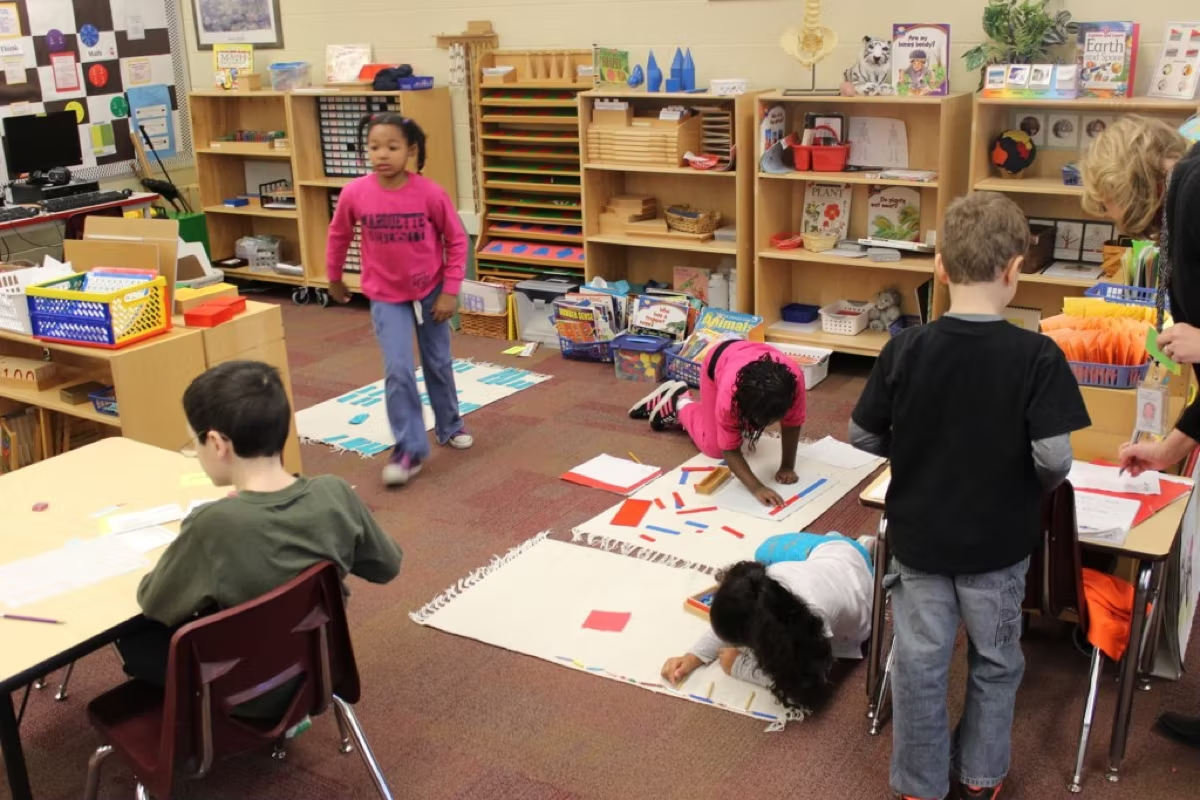
Image source: Wikimedia Commons
9. Teacher Preparation Is Non-Negotiable
Montessori implementation quality is highly dependent on teacher training. The American Montessori Society identifies five components of high-fidelity practice: trained teachers, multi-age classes, Montessori materials, child-directed work, and uninterrupted work periods.
Comprehensive preparation pathways (including major recognized Montessori routes) typically cover:
- child development,
- lesson presentation sequence,
- observation and record systems,
- classroom leadership,
- family partnership,
- supervised practicum.
Montessori cannot be reliably replicated through materials alone.
10. What One Stronger Study Found—and What It Did Not
A 2017 longitudinal study followed 141 children who had entered two public Montessori magnet preschools through a randomized lottery. Across three years, the Montessori group showed stronger growth in academic achievement, social understanding, mastery orientation, and reported enjoyment of schoolwork. Executive function was higher only at age four, not across every measurement point. The full methods and limitations are available in the open-access study by Lillard and colleagues.
That result is encouraging, but it is not a guarantee that any school using the Montessori name will produce the same outcomes. The study examined specific high-fidelity classrooms, and the authors called for a larger study. Program quality, teacher preparation, family context, and comparison-school quality all matter.
11. Common Misunderstandings
Misunderstanding 1: Montessori is unstructured
Reality: Montessori is highly structured, but structure is embedded in environment and workflow rather than constant verbal control.
Misunderstanding 2: Montessori is only for early childhood
Reality: principles extend across developmental stages, though implementation evolves by age.
Misunderstanding 3: Montessori is anti-academic
Reality: Montessori is academic, but sequencing follows developmental readiness and concrete foundations.
Misunderstanding 4: Montessori is only for wealthy schools
Reality: core principles are environment- and practice-based; strong implementation can be adapted to varied budgets.
12. Home and School Implications
If Montessori is a whole system, implementation strategy should be systemic too.
High-impact priorities:
- simplify and prepare environment,
- protect uninterrupted work blocks,
- use observation-informed intervention,
- align freedom with clear boundaries,
- maintain adult consistency and reflective practice.
Partial adoption can still help, but coherent adoption is where transformation occurs.
Conclusion
Montessori is not a trend, a shelf style, or a material catalog.
It is a coherent developmental system integrating child science, environment design, pedagogy, and professional adult practice.
Its central contribution is not simply helping children "learn more."
It helps children become:
- self-directed learners,
- precise observers,
- capable collaborators,
- and resilient problem-solvers.
When Montessori is understood and implemented as a system, the old debate of "good or bad" becomes too shallow.
The real question becomes:
Can we create conditions where children can build themselves with freedom, structure, and dignity?
Three Questions to Ask Before Choosing a Montessori School
- What Montessori credential does the lead teacher hold for this age level?
- How long is the uninterrupted work period on a normal day—not on an open-house day?
- Which age span shares the classroom, and how long do children usually remain with the same guide?
Those answers reveal more than a shelf of wooden materials. They show whether the parts of the system described above are present together.
Keep exploring
Related reading
- Philosophy
5 Montessori Ways to Build a Confident Child
Five practical Montessori ways to build lasting confidence through a prepared environment, independent work, manageable challenges, and learning from mistakes.
- Philosophy
Build a Montessori Morning Routine at Home: 5 Steps to Fewer Reminders
Use environment and sequence instead of constant prompting to help children start the day with more independence and order.
- Philosophy
The Art of Observation
Observation is the most important tool for any Montessori adult. Learn how to step back and truly see the child.